![Sonic Curiosity [October 2005]](https://joedeninzon.com/wp-content/uploads/2011/06/sonic_curiosity.jpg)
by Joe Deninzon | Oct 29, 2005 | Articles
JOE DENINZON: The Adventures of Stratospheerius (CD on D-Zone Entertainment)
Russian-born/Cleveland-bred/New York-based violinist Joe Deninzon has played with Sheryl Crow, Smokey Robinson, Johnny Mathis, Jay and the Americans, Everclear, and many more. On this 70 minute CD from 2002, Deninzon spreads his solo wings (accompanied by a full back-up band who superbly flesh out the songs).
While rooted in a rock foundation, this music employs elements of power jazz and sultry funk to produce an exuberant frenzy that is quite comparable to Joe Satriani (if that Joe’s instrument were a smoking violin instead of a guitar). Deninzon’s violin mastery belts out riffs that delightfully blazes with searing riffs, plunging the music into a fiddle frenzy that bestows the tuneage with unbridled energy.
Fleshing out the Stratospheerius sound are: sultry guitar, rumbling basslines, frantic drumming, sinuous keyboards, and celebratory vocals that enunciate lyrical outlines of life.
The songs are gripping and energetic. Insistent melodies are made compelling by the violin passion. Fevered solos are cradled between lyrical passages that tremble with breakout rock stamina. A Bayou flavor lurks in several tracks, creating a strange fusion of bluesy funk and studied progressive tendencies. The result is goodtime music that will get you dancing.
![Heyoka Magazine [July 2005]](https://joedeninzon.com/wp-content/uploads/2011/06/heyoka.jpg)
by Joe Deninzon | Jul 29, 2005 | Articles
John LeKay: Music is obviously in your blood I don’t think that playing the violin the way you do is something that can be easily taught or learned. I know that you were born in St. Petersburg Russia and that both your parents were classical musicians. What instruments did they play and what kind of influence did this have on you taking up the violin and how old were you when you first began playing?
 Joe Deninzon: My parents are both classical musicians. My father is a violinist with the Cleveland Orchestra, and my mother is a concert pianist, so I started out with music in the womb and in the house as I was growing up. My parents are also busy teachers, so there would be constantly multiple violin and piano lessons going on in the house. I was originally classically trained on the violin, starting at age 6. We emigrated to the states from Russia when I was 4. At around age 8 or 9, I started watching MTV and was seduced by the sights and sounds of Van Halen, Michael Jackson, yes, and just about everything in the pop mainstream that was floating around in the mid eighties.
I wanted to be a rock star and started rebelling against my parent’s strictly classical teachings. This lead to my later taking up bass, guitar, and writing and singing my own songs. The first instrument I learned to improvise on was the electric bass when I joined my high school jazz band at age 15. My heroes, growing up, were Led Zeppelin, Kiss, Aerosmith, Jaco Pastorius, John Mclaughlin, and Miles Davis. During these years, I still kept on with my classical violin studies, but it was a separate world from my jazz and rock dabblings.
Two pivotal things happened that led to me becoming a jazz/rock violinist. When I was 16, a local Cleveland songwriter with a string of minor hits, named Michael Stanley, invited me to perform with his band on the violin. I had never improvised on the violin before, but I knew the language from playing bass and guitar. The audience responded very well to what I was doing, and I realized that I could really stand out if I kept developing my jazz violin chops. Later that year, my father bought me a Grappelli/Django recording, which completely changed my life and opened my ears to all the possibilities.
As far as phrasing, I think I was more influenced by guitarists than violinists. Some of my favorite players of all time are Django Reinhardt, Jimmi Hendrix, John McLaughlin, John Scofield, Pat Metheny, and Steve Vai. I guess you could say I’m a guitarist trapped in a violinist’s body.

JL: In reference to the two pivotal things that led you to becoming a jazz/rock violinist and composer; how did it feel taking the leap from the world of classical violin to the world of improvisational jazz and rock? Also can you please describe what it is about Django’s guitar playing in particular, that has had such an impact on your music?
JD: I think what inspires me the most about Django’s playing, besides the immense virtuosity, is the Gypsy spirit and unique phrasing he brought to the music. Although Jazz is rooted in the history of Black America, anyone in the world who becomes a jazz musician brings their own heritage into it, thereby enriching the Jazz tradition. I think Django was one of the first to bring a European flavor to jazz. His phrasing was very unique for its time, and his style is such that it spawned a whole school of guitar playing that continues to this day. There is a distinct French-ness to compositions such as “Nuage”. I respect Django because he did not try to imitate the great jazz musicians from America, ( although I’m sure he was influenced by them), but put his stamp on the music. He was proud of where he came from and who he was. My roots being in Russia, I am a big fan of Gypsy music from Eastern Europe, and I can relate to the way Django plays, and probably have adopted some of his phrasing into my playing.
The transition to becoming an improvising violinist for me was relatively easy, because I had been playing guitar and electric bass for 4 years prior to my first improvisational violin experience. I had a basic knowledge of jazz, blues, and rock language. It was just a matter of finding the fingerings on the violin to execute the lines I was hearing in my head. Learning improvisation is very different from studying classical music. When practicing a concerto, you are dealing mainly with phrasing and articulation, and mastery of difficult passages. Once you memorize the piece and bring it to a good performance-ready level, you know you can move on to the next project. When you practice improvised music, you are theoretically analyzing everything you play. There is, initially, a lot of brainwork involved. A great deal of ear training and understanding of harmony. also, it is open-ended. you are never “finished” working on a piece because there are infinite things you can do with everything you work on. Also, a concept or lick you learn could surface in your playing months or years after the time that you practice it. I think one uses a different part of their brain when practicing jazz vs classical.

JL: I find it amazing that Django could not read or write and could not take musical notation and had to rely on someone do this for him. Also that he never played the same piece, the same way twice. When you said there are infinite things you can do with everything you work on, are you also this way in terms of approaching your own work and playing the same piece in different ways. Also do you use a particular method of taking notation or recording, during the early composition and creative stages, especially in terms of harmonic conception and the spontaneous development of melodic and rhythmic ideas and solos etc.?
JD: In answer to your question. I have different ways of writing. Sometimes a whole song will come to me in a flash, and I’ll write it down as if it was always there. Usually, I get these flashes at random moments. In the middle of the night, in the shower, when I’m jogging, etc.
The rest of the time, especially lately, I get bits of melodies that stick in my mind. So I keep a journal of licks and phrases. Sometimes I’m working on a composition and I have a space I need to fill, so I’ll look through my “riff diary” and find something that works, or that I can slightly alter to work in the given situation. Sometimes, a riff can lie around for years before I find a way to apply it to something.
Once the main structure of the song is created, it takes on a life of its own as my band performs it over time. Once the song has really gotten under our skins, we feel free to change the arrangement or the groove on a whim.
I never feel like a song is “finished”. To me, it’s a living breathing thing that is constantly changing, so I understand why Django could never play a song the same way twice. I can relate to that.
Unlike Django, I’m a very notation-oriented guy. I write everything down. This is good because I can compose while flying on a plane or in the back of a taxicab. Like Django, many great artists, especially in the world of rock, from Jimi Hendrix to Paul McCartney, never learned to read or write music. It is not a necessity, but I think it gives you more freedom if you know how. I heard that Michael Brecker could not read music until he was 18.

JL: What’s the musical landscape like out there in terms of playing classical music and how is the highly advanced studio recording technology and computers changing the way music is being recorded and released? Also can you tell me some of the musical tips you use to teach your students?
JD: In today’s musical landscape, string players have to be more versatile than ever to survive. Orchestral positions are few and far between, and increasingly hard to land, and many orchestras are folding or giving their musicians pay cuts. Meanwhile, conservatories continue to crank out many excellent classical players. The competition is fierce, and many people who spent their whole life focusing on classical music and not exploring other avenues, find themselves switching careers when they are not able to make a living doing what they trained to do. In many cases, musicians are not aware of all the opportunities that exist outside of the classical world. Therefore, I think it is crucial for any string player (or any musician for that matter), to study improvisation in many styles as well as composition. Even though I was classically trained on the violin, and studied jazz for many years, I find that a small percentage of my work is strictly classical music or traditional jazz. I have played with and arranged for many pop and rock singer songwriters and bands, blues groups, fusion bands, DJ’s, Italian, Brazilian, and Sephardic world music ensembles. Even though every style of music requires a different approach and different language, the skills I learned initially were a doorway to all of these styles.
With my students, I usually divide the time equally between classical and non-classical styles. We spend a great deal of time working on classical technique and repertoire, which I feel is the foundation for everything else. The second half of the lesson is usually spent working on a variety of things dealing with improvisation. The first thing I teach is the blues, which is the cradle of most popular music in the 20th century and beyond. We learn about jazz theory and harmony, learn as many standards as we can. I also try to educate them on techniques for playing rock and working with effects. I try to encourage my students to write their own songs and give them as much advice as I can. It’s fun to to re-create for my students some of the experiences that brought me where I am today.
I think there is a growing movement in improvisational education for strings in this country. More colleges are offering jazz string programs, and Mark O’Conner’s Fiddle Camp has become a Mecca for string players who want to expand their horizons.
As for your question about technology, I think the growing development of Protools, Logic, and all the home recording technology is putting a great deal of power and creativity into the hands of musicians and putting big studios and record labels out of business. It is much easier to produce and manufacture a good sounding CD at home and distribute it on the internet. You can act as your own producer, engineer, radio promoter, publicist, etc. There are also thousands of mechanisms that can alter the sound of your instrument. Midi has enabled a violin to sound like a flute or a french horn. All the effects that I like to use can allow you to paint with more colors than ever. I think the challenge is to use the technology in a tasteful and musical way and not as a gimmick or novelty. That is a journey that every musician has to make. It’s a personal decision as to what you want technology to do for you and to what extent you want to use it.
JL: Can you tell me about your band Stratospheerius and the most recent pieces you have been working on? Also what plans do you and your band have for the future?
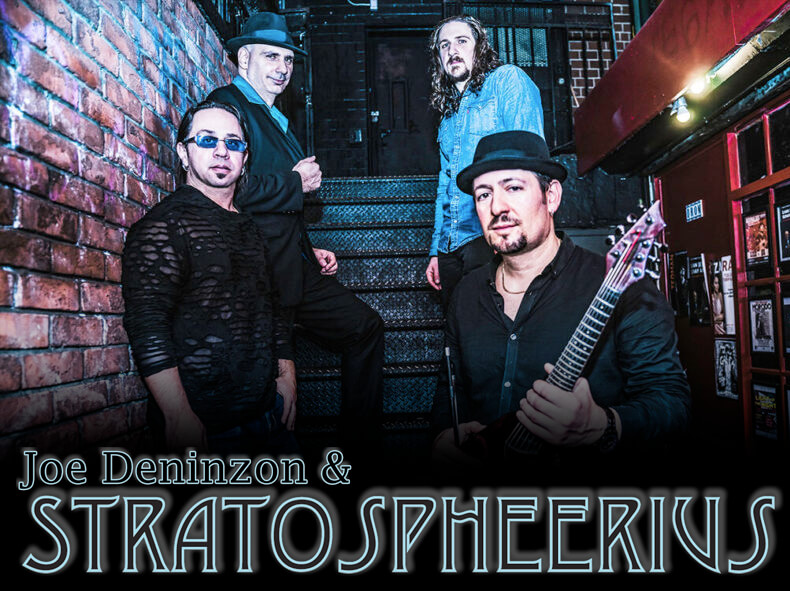
JD: Stratospheerius is my vehicle to explore the endless scope of sounds that a violin can create, especially when put through a variety of effects. I have always been fascinated by sounds and textures, and am a proud fan of fusion music, especially that which was created in the early seventies by the likes of Miles Davis, Mahavishnu Orchestra, Frank Zappa, and Jean Luc Ponty. Jean Luc, who was highly influenced by Grappelli, was probably the most important jazz violinist of his generation. He and Jerry Goodman were two of the early players to use distortion, wah, and delay on the violin. There is an art and a skill to tastefully playing with effects and not using them as a gimmick. When one listens to guitarists from Jimi Hendrix to John McLaughlin, Steve Vai to Dave Fiuczynski, and most recently Oz Noy, one realizes that guitar players and as well as keyboard players have made leaps and bounds in effectively applying sound effects to music in the last 30 years. String players are still behind in this technique, in my opinion, and there are plenty of things to explore. Stratospheerius is a 4-piece band consisting of bass, drums, guitar, and myself on vocals and 4, 6, and 7-string electric violin. Our music is a mixture of funk, jazz, worldbeat, and jam-rock. Heavily influenced by the artists I mentioned above, as well as pop groups like Dave Matthews and Sting.
Having released a very successful live CD that has been getting heavy airplay, we are currently preparing to record a new studio album (which will be our fourth), and continue touring.
In addition to this, I have 70% of an acoustic album recorded, which will probably include the version of Nuage that you heard. This is a complete departure from Stratospheerius, and consists of an acoustic violin, upright bass, and guitar. Nothing was plugged in or overdubbed. I hope to have it out sometime next year.
![Erie Times-News [June 2005]](https://joedeninzon.com/wp-content/uploads/2011/06/erie_times-news.jpg)
by Joe Deninzon | Jun 29, 2005 | Articles
CAUGHT IN THE ACT
By Dave Richards
 JOE DENINZON WAS BEYOND PLEASED WHEN RANDY HETHERINGTON SECRETLY RECORDED DENINZON’S WHOLE ERIE SHOW LAST YEAR
He was caught in the act, live. But instead of feeling violated, Joe Deninzon was elated. He never sounded so good.
When Deninzon and his band Stratospheerius played at Forward Hall in April 2003, he was unaware that sound engineer Randy Hetherington recorded the entire show from his Oz-like enclave behind the stage.
“I was so in the moment, I hadn’t noticed he put mics around the amps and drums and spontaneously recorded the set,” Deninzon said in a phone interview. “When we were done, he led me to his secret laboratory behind the stage, where the big studio is, and started playing us the show. I was like,’Wow! This is killing me.”
Deninzon was so pleased with how his jazzy jam-funk band tore it up that night he decided to release it. All but two of “Live Wires” sizzling tracks were recorded at Forward Hall. The artist believes it turned out better because he was unaware he was being recorded.
“The best stuff, I’ve found, comes when you’re completely not self-conscious and letting inspiration fly,” he said. “He captured a moment, which was one of our best shows.”
Others agreed. With “Live Wires,” Deninzon beat out hundreds of acts to wqin the best-jamband category in the fourth Independent Music Awards in January. Judges included Delbert McClinton, Erukah Badu, Victor Wooten, and Loudon Wainright.
“What’s That Thang,” the soaring, supercharged lead-off track, is included on the compilation CD, drawn from 2004 IMA winners.
DENINZON PLAYS ELECTRIC violin, not exactly your standard jam-band instrument. But he wails on it as wildly, furiously, intensely as Hendrix attacked his guitar. He studied classical music as a youth, and still loves it. In fact, his wife, Yulia Ziskel, is first violinist witht eh New York Philharmonic.
“When I teach my students, I encourage them to keep up with classical studies, even if they want to be rock violin players.That’s the foundation of everything,” Deninzon said. “But I was also drawn to rock and roll at an early age and fell in love with it. I felt it was a great way to communicate with people and felt it was something I could do well and I felt free doing it. As much as I enjoy classical, I feel there’s a limitation on how you can express yourself in that medium.
His love for jazz and classical shine through on “Live Wires.” So does a sense of playfulness, evidenced by Stratospheerius interpreting-ahem-Danny Elfman’s theme song from “The Simpsons.”
Doh!
“It’s a fun thing,” Deninzon said. ‘A lot of people love it, and radio picked it up even more than the other stuff. It’s a song that everyonbe knows. A lot of rock bands cover his music. He’s a great composer.
Deninzon includes that “The Simsons” theme on “Live Wires,” which has put his career into overdrive. It’s earned airplay across the country as well as overseas in Italy, Russia, and other countries. His CD also made the top 20 list for XM Radio’s “Jazz and Beyond.” Chick Corea took the No. 1 spot.
“It’s been a really good year,” Deninzon said. “We found out about the IMA award in January, and we’ve gotten heavy radio promotion all around the country. We’ve gotten into a lot of good festivals over the summer.”
Last Saturday, he played at the massive Riverbend Festival in Chattanooga, Tenn, which also featured Big & Rich, Trace Adkins, Pat Benatar, and others. But he’s happy to return to the scene of the crime-Forward Hall-on Friday.
“I hope it has the same spontaneous, wild feel that we had for the live one,” he said. “I’m excited about the new music we’re putting together, and we’ll be performing some of it in Erie. So we’ll see what happens.”
![Live Wires: NewBeats.com [2005]](https://joedeninzon.com/wp-content/uploads/2011/06/newbeats.jpg)

![Live Wires: ProgSheet [2005]](https://joedeninzon.com/wp-content/uploads/2011/06/progsheet1.jpg)
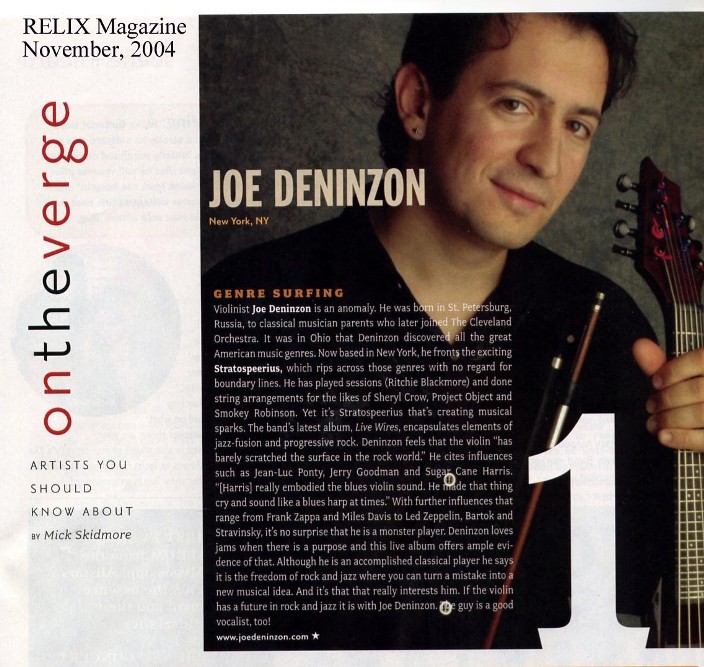
![Relix Magazine [November 2004]](https://joedeninzon.com/wp-content/uploads/2011/06/relix.jpg)